OekRKOe_logo50x50.gif (1207 Byte) The Ecumenical Council of Churches in Austria

Its history and its work

1. Beginnings and Membership

The world-wide Ecumenical Council of Churches was founded in Amsterdam in 1948. The head office is located in Geneva. The Ecumenical Council of Churches in Austria (ÖRKÖ) was founded ten years later. The founding members were the Old Catholic Church, the Evangelical Lutheran Church (A.B.), the Evangelical Reformed Church (H.B.) and the Methodist Church. The Orthodox churches represented in Austria became members of the Austrian Council in the years following the 1961 assembly in Dehli.

The 1993 Decree on Ecumenism enabled the Roman Catholic Church in Austria to join the Council. Subsequently the Roman Catholic Church in Austria became a full member on 1 December 1994, although it enjoyed observer status as early as 1970 and was a constructive partner throughout the preceding years. It follows that the ÖRKÖ comprises churches of drastically varying size. This problem was solved by allowing representation according to a church’s respective size. Each member church has at least one representative, but no more than ten. Presently the ÖRKÖ has 14 member churches. In addition to these there are a number of churches and church organisations that enjoy observer status.

2. Goals

The constitution of ÖRKÖ defines its goal as follows: “The purpose of the Ecumenical Council of Churches in Austria is the joint realisation of ecumenical tasks. The Council sees its particular commission to realise the ecumenical idea in Austria by making this ideal known and by deepening it in the life of the churches (Gemeindeleben). The Ecumenical Council of Churches in Austria nurtures contacts with the World Council of Churches, the Conference of European Churches, the European Bishops´ Conference and the Ecumenical Councils of other countries. Further the Council seeks to develop the relationships between the various churches. This is done primarily through theological conversation, the exchange of experiences and in planning and realising those services which are specifically church related.

3. The main work of the Council

3.1 Services

Since 1959 the ÖRKÖ has hosted a service in the Week of Prayer for Christian Unity (between 18-25 January). Each year a different member church hosts the service. The preacher is always from another confession than the host church. In recent years there has also been a service on the 17 January entitled the Day of Judaism. It is a fixed date in the annual calendar of the ÖRKÖ.

3.2 Church and Society

In 1986 the ÖRKÖ decided - together with the Austrian Bishops’ Conference - to accompany the conference of the Organisation for Security and Co-operation in Europe (OSCE) which that year was meeting in Vienna. Working closely together the churches informed the diplomats attending the conference about the life of the churches in Austria. Further they invited the delegates to church services and organised receptions. In turn the diplomats were given an opportunity to inform the churches about the challenges and opportunities facing the conference.

In 1989 the Conference of European Churches (CEC) and the Council of the European Bishops’ Conference (CCEE) invited the churches to Basel for the first European Ecumenical Conference. One concrete result of the intensive preparations and follow-up to the conference - as well as the experiences made accompanying the OSCE conference in Vienna - was the setting up of the permanent working group ”For Church and Society”.

3.3 Der Christentag

The impulse for the Austrian Christentag (Day for Christ) derived from the Second European Ecumenical Meeting, which was held in Graz in 1997. The theme of the Christentag was “Sun of Righteousness rise in our time” and covered the following themes: Solidarity amongst peoples, There is no peace without justice, Church reconciliation, Reconciliation amongst peoples. In the run-up to Advent Sunday seminars, symposia and other events were held.

3.4 Declarations

Over the past few years the ÖRKÖ has made declarations on various topics:

Against xenophobia
Dying with dignity
Questions to political responsibility
EU-Expansion
Against the war in Iraq

3.5 Study Days

The ÖRKÖ alone and sometimes together with other bodies has initiated a number of study days (usually within the “Church and Society” working group’s brief ), i.e.
Human rights and xenophobia together with the Vienna Jewish Community (Israelitischer Kultusgemeinde)
Tolerance together with Union of Baptist Churches
The Duties of the State together with Justitia et Pax

The United Nations and the World Council of Churches have both initiated a decade entitled “Overcoming violence”. In Austria these two initiatives are closely linked. Since the year 2000 an annual study day has been held with this theme. In 2003 the theme was “Violence in language”.

3.6. The Year of the Bible


2003 the ÖRKÖ took on the patronage for the activities linked to the Year of the Bible. In conjunction with the Ministry for Education to it was possible to launch a school competition on the theme “The Bible in Culture and Society”.

3.7 Bio-ethics

The Council has not issued a declaration concerning bio-ethics; nevertheless the council follows the discussions closely. Detailed information on this subject can be found on the ÖRKÖ’s website.

3.8 Das Sozialwort / Declaration on social issues

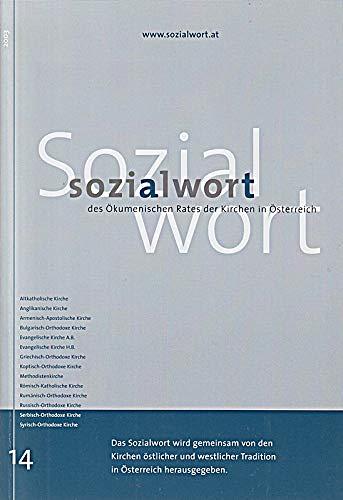
The Sozialwort is of special importance to the work of ÖRKÖ. The Sozialwort was presented to the public on Advent Sunday 2003. After a period of intensive consultation, lasting four years, it was possible to write a text that has found acceptance amongst the fourteen churches belonging to the ÖRKÖ. In this text the churches address mutual problems of our society, while at the same time making their own perspectives known on various topics. It is not the final word, but rather an invitation to all, to face the actual challenges of our world and to look for possible solutions, which will serve people, while at the same time enabling us to take seriously our world as a part of creation. In the years to come the continuation of the process of reception will remain a focus of the ÖRKÖ’s work.

© 2000 - Eine Information des Ökumenischen Rates der Kirchen in Österreich